What Problem Do Shaft Grounding Rings Actually Solve?
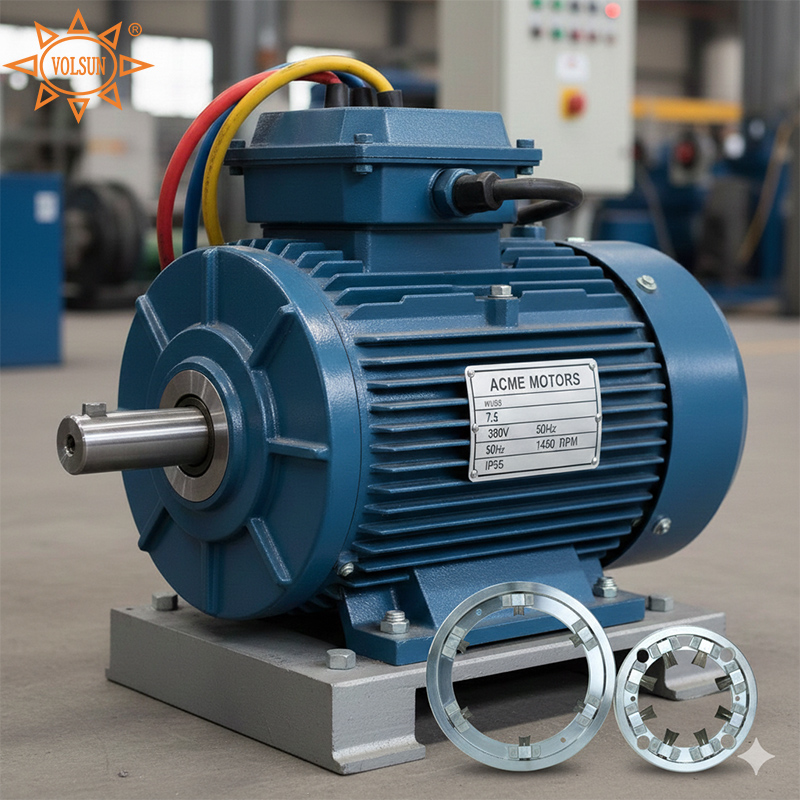
In the world of Variable Frequency Drive (VFD) systems, a shaft grounding ring is often misclassified as a simple "add-on" or an optional accessory. This is a fundamental misunderstanding. In reality, a shaft grounding ring is a critical failure control node.
Its job isn't just "grounding" in the general sense; its specific purpose is to interrupt the destructive electrical discharge path that naturally forms between a motor's spinning shaft and its internal bearings. Without this node, the motor is essentially designed to destroy itself from the inside out.
How Shaft Voltages Are Generated in VFD Motors
To understand the solution, you must identify the two specific starting points of the "cause-and-effect" chain:
Common-Mode Voltage: VFDs do not provide pure sine wave power; they create a voltage imbalance that looks for a path to the ground.
High dv/dt: The rapid switching speed of modern drives creates high-frequency voltage spikes that "jump" across the thin film of oil inside your bearings.
Primary Bearing Failure Modes Caused by Shaft Currents
If these currents are not diverted, they lead to three specific engineering consequences:
- EDM Pitting: Thousands of microscopic electrical arcs blast tiny craters into the bearing races, leading to immediate surface degradation.
- Fluting: These pits eventually align into washboard-like ridges, causing distinct, high-pitched noise and destructive vibration.
- Premature Grease Breakdown: The heat from the electrical arcs "cooks" the lubricant, turning it into a blackened, gritty substance that fails to protect the metal.
How a Shaft Grounding Ring Interrupts These Failure Paths
A grounding ring works by providing a path of least resistance. However, its effectiveness is not guaranteed by its mere presence; it is governed by specific logic:
It works only if the conductive fibers maintain a constant, low-impedance connection with the spinning shaft.
It fails when heavy contamination (like oil or thick dust) creates an insulating barrier between the fibers and the metal, or if the ring is installed on a painted/coated surface that blocks the path to the motor frame.
Engineering Limits: When a Grounding Ring Alone Is Not Enough
While highly effective, a shaft grounding ring is not a "magic bullet" for every scenario. There are specific engineering limits where a single ring cannot handle the electrical load:
High Power VFDs: Large motors (typically over 100 HP) generate circulating currents that often require more than just a ring at the drive end.
High dv/dt & Long Cables: Systems with exceptionally long cable runs increase the "reflected wave" effect, pushing the limits of what a standard ring can divert.
The Insulated Bearing Requirement: In many high-capacity systems, you must combine a grounding ring at one end with an insulated bearing at the opposite end to fully break the circuit.
Key Takeaway for Engineers
The bearing is the fuse: If you don't provide a grounding ring, the bearing will act as the electrical circuit's weakest link.
Installation is the variable: A perfectly manufactured ring will fail if the contact surface isn't cleaned to bare metal.
System size dictates strategy: For large-scale or high-voltage applications, a grounding ring should be viewed as one part of a multi-point mitigation strategy, not a standalone fix.
- CONTACT TEL: +86-512-66386808
- SALES CONTACT: volsun2006@szvolsun.com