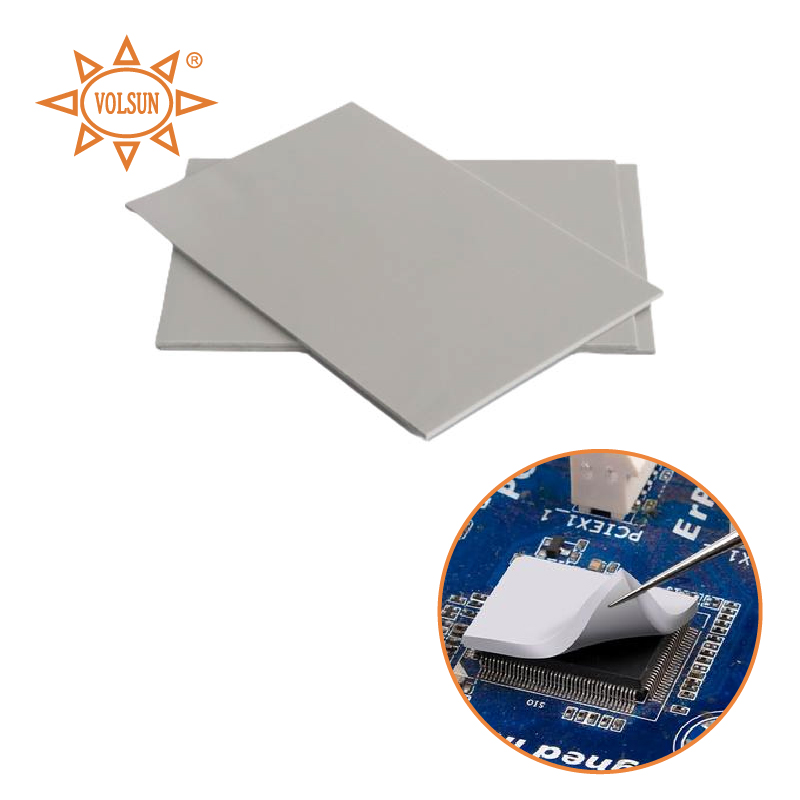
A silicone thermal pad is a soft, pre-formed sheet of thermally conductive silicone rubber that sits between a heat-generating component and a heatsink, enclosure, or chassis to pull heat away. It works by conforming to both surfaces, squeezing out the microscopic air trapped in the gap — air is a poor conductor — and giving heat a low-resistance path to the cooler side. Think of it as a "thermal bridge" that fills uneven gaps so the heatsink can actually do its job.
What Exactly Is a Silicone Thermal Pad?
It is a type of thermal interface material (TIM) made from silicone loaded with thermally conductive fillers. VOLSUN supplies it as a flexible grey sheet, typically 0.5–5.0 mm thick, delivered with a protective release film you peel off before use. Unlike runny thermal grease, it is a solid, dry-to-touch pad that holds its shape, will not pump out, and can be cut to size with ordinary scissors.How Does It Work?
Every heatsink mounting leaves a tiny air gap because neither the chip nor the sink is perfectly flat. Air traps heat. The pad's softness lets it compress and conform to both surfaces, replacing air with silicone that conducts far better. The result is lower thermal resistance at the interface and a cooler, longer-lived component.Key Properties That Matter
| Property | Typical range (VOLSUN pads) |
| Thermal conductivity | 1.5–6.0 W/m·K |
| Thickness | 0.5–5.0 mm |
| Hardness (Shore OO) | 30–70 (ultra-soft grades <10) |
| Flame rating | V-0 |
| Operating temperature | −40 °C to +200 °C |
| Compliance | RoHS, REACH |
The pads also stay electrically insulating (volume resistivity ≥10¹² Ω·cm, dielectric strength >6 kV/mm) — they move heat, not current.
Silicone Pad vs Other Thermal Interface Materials
| Option | Form | Best when |
| Silicone thermal pad | Pre-formed sheet | Gaps are uneven; clean rework matters |
| Thermal paste / grease | Paste | Ultra-thin, perfectly flat interfaces |
| Phase-change material | Sheet, melts on heat | High-volume automated lines |
Where Thermal Pads Are Used
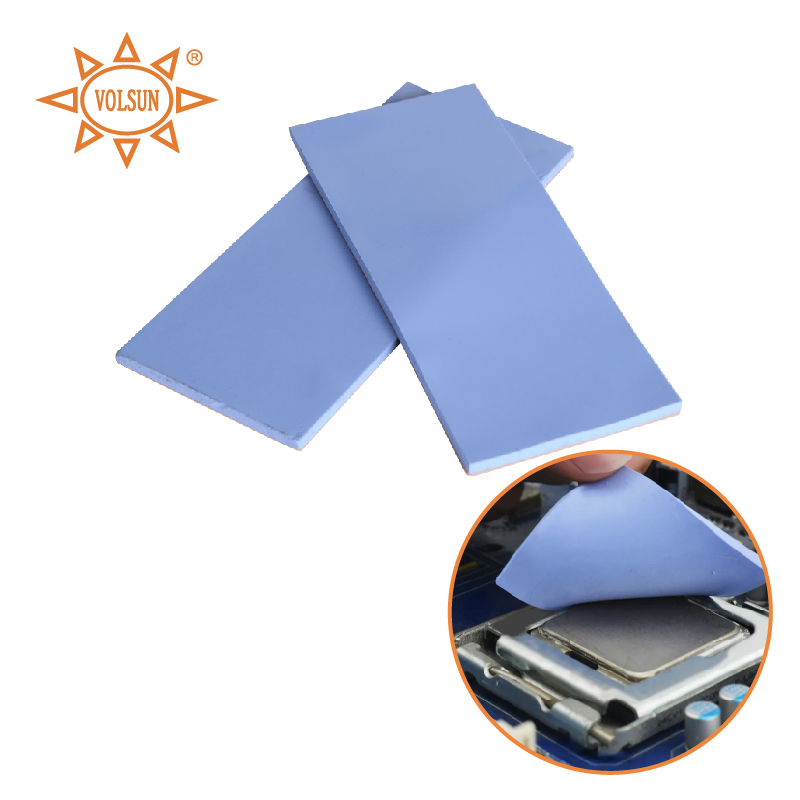
They sit between power devices and cooling plates in communication base stations, power supplies, EV battery packs, LED modules, industrial controllers, and consumer electronics — anywhere a chip, MOSFET, capacitor bank, or memory module needs to shed heat into a metal surface.VOLSUN Product Match
VOLSUN makes a full conductivity range so you can match the pad to the job:- GP1501 / GP2001 / GP3001 / GP4001 / GP6001 — 1.5 to 6.0 W/m·K, the standard grey series for most power and electronics cooling.
- GP3001-PI — same 3.0 W/m·K performance with a polyimide (PI) reinforced surface for extra handling strength and isolation.
- GP1002-SI — ultra-soft (<10 Shore OO), low-temperature rated to −60 °C, customizable color; ideal for tight gaps and cold environments.
Thermal conductivity and other figures are typical values measured under standard test conditions. Real performance depends on contact pressure, surface flatness, and gap size. Note that higher W/m·K grades are stiffer and more brittle, so they need more assembly pressure — pick the lowest conductivity that meets your thermal budget.
A silicone thermal pad is the simplest, cleanest way to bridge the air gap between a hot component and its heatsink. Choose by thermal conductivity, thickness, and hardness, and you get reliable cooling without the mess of paste. Need help matching a grade to your application? Contact the VOLSUN team for samples.
- CONTACT TEL: +86-512-66386808
- SALES CONTACT: volsun2006@szvolsun.com